

The brothers we now know as Cyril and Methodius were more than missionaries. They became almost archetypal figures— symbols of the meeting of two worlds, two ways of understanding the sacred, two languages of the spirit. Each followed his own path, but it was their shared mission that opened the space for their greatest achievement: an alphabet designed to express the soul of the Slavic people.
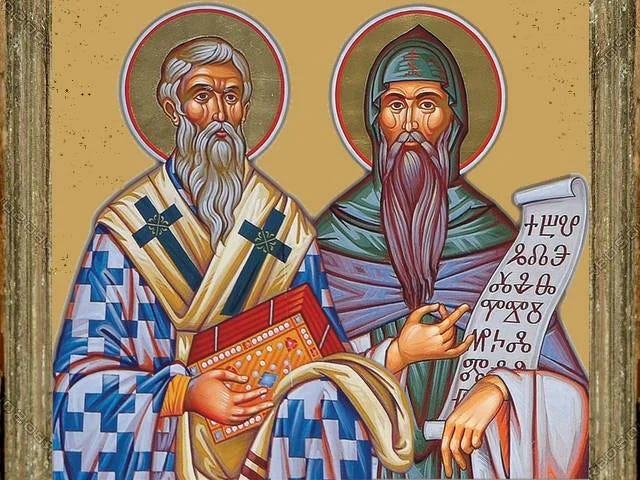
Constantine—later known as Cyril—was already considered an exceptional figure during his lifetime. Renowned for his remarkable intellect, openness to diverse cultures and languages, and ability to combine mystical insight with logical clarity, he studied in Constantinople, the heart of the Eastern intellectual world. There, he immersed himself not only in the philosophies of Plato and Aristotle, but also in the deep layers of mystical Christian theology. Fluent in Greek, knowledgeable in Latin and Semitic languages, he also studied oriental tongues, which in Byzantium were seen as keys to understanding the universal message of Christianity.
Methodius, in contrast, had a more grounded and reserved temperament. Before entering monastic life, he held a high administrative post in the imperial bureaucracy, which gave him a pragmatic perspective, a sense of realism, and the ability to organize communal life. He was a man of action and discipline, and together with Cyril’s intuition and vision, they formed an almost ideal missionary partnership—one the inspirer, the other the implementer, a unity of inspiration and realization.
It was Cyril who, in response to Rastislav’s call, undertook a task that would become one of the most profound intellectual, spiritual, and cultural breakthroughs in European history: the creation of the Glagolitic alphabet. The challenge before him was extraordinary—to provide the Slavs with a tool for expressing the sacred in their own language, a language that, according to modern scholarly consensus, likely had no formal written form at the time. The alphabet he created was far more than a method of transcription. At first glance, it bore the marks of deep reflection, spiritual meditation, and intentional symbolism.
Glagolitic was unique not only linguistically, but visually. Its letters took the shape of mysterious geometric forms—reminiscent, perhaps, of characters from Greek, Hebrew, or Coptic scripts—yet also entirely original, rooted in a symbolic-spiritual order. Contemporary research into the history of writing confirms that Glagolitic’s aesthetic was based on three key geometric figures, each of which held deep spiritual resonance: the cross, the triangle, and the circle.
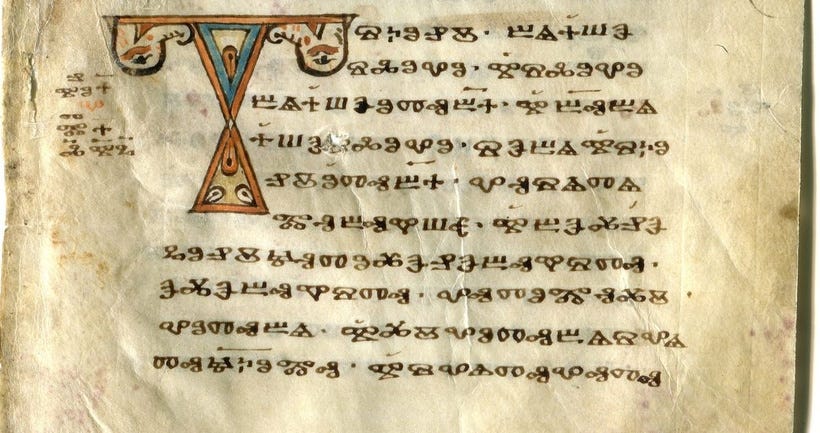
The cross, in a Christian context, is the clearest symbol of the sacred—a point of meeting between heaven and earth, the divine and the human, spirit and matter. But for the Slavs, the cross also had pre-Christian meanings: it represented the four directions, the four seasons, the four elements, with its center—the crossing of arms—symbolizing the center of the cosmos, the axis mundi. Thus, in Glagolitic, the cross could unite both realms: the Christian mystery of the crucifix and the Slavic cosmology of cycle and harmony.
The triangle, long associated with perfection and unity, symbolized in Christianity the Holy Trinity—the relationship of Father, Son, and Holy Spirit. In ancient Slavic culture, the number three also held special significance: it signified balance, dynamic wholeness, and appeared in folk tales (three trials, three sisters, three brothers) and rites of passage. Triangular forms in Glagolitic letters could thus evoke both divine order and the rhythmic, tripartite cycles of life and nature.
The circle, meanwhile, is a universal sign—of eternity, infinity, completeness, and wholeness. In Glagolitic, it appears not only as a visual element but as a symbolic resonator of timelessness and the universal nature of the written message. For the Slavs, the circle was tied to the rhythms of nature—the movement of the sun, the turning of the year, the cycle of life and death. In its form lay the belief that all things return, all things complete themselves, and language—like life—moves in a circle.
The combination of these three figures—the cross, the triangle, and the circle—gave Glagolitic a mystical dimension. They were not mere decorative elements, but symbols of spiritual order: the meeting of the earthly and the divine; the balance of forces and seasons; the return to wholeness. Their presence in the structure of the letters made the alphabet not only a system for recording sounds, but a vessel of meaning—felt intuitively and visually even before it was read.
Each letter, then, was crafted with more than phonetics in mind. It was designed as a carrier of symbolic and spiritual resonance. Cyril, the philosopher and mystic, seemed to compose Glagolitic like a mandala—each letter a microcosm of meaning, numeric value, and form, resembling gestures of prayer or mystical symbols. This was not merely a script—it was a spiritual path, a tool for meditation, perhaps even a form of initiation into the mysteries of faith and knowledge.
It is no coincidence that Cyril began his translations with the Gospel of John—the most symbolic and spiritual of the four Gospels. Its opening words, “In the beginning was the Word,” took on new meaning—they became Slavic words, written in letters shaped by a man deeply attuned to the symbolic and mystical heritage of his culture. Glagolitic was created not only to carry the Divine Word in the Slavic tongue, but to elevate it—through form, symbolism, and rhythm—into a mode of contemplation and spiritual practice.
The creation of Glagolitic, then, was not merely a pragmatic endeavor. It was a deeply symbolic act—a declaration that the sacred does not belong to one language or culture alone, but can be expressed by every people in its own unique way. In creating this alphabet, Cyril gave the world more than a writing system. He created an alphabet of the spirit—one that continues to inspire reflection, contemplation, and quiet insight to this day.
This fragment comes from my work-in-progress book. As I move forward with the project, I plan to share various pieces of it to give readers a glimpse into the world I’m creating. If you enjoy this material, you can access the current version of the book through a paid subscription. And if you feel drawn to the project and would like to help shape its future, I’d be delighted to collaborate with you. :)