

At this stage, it would be easy to believe in an overly convenient image of the human being.
After the texts on attention, perception, affordances, learning, memory, language, and thinking, one might get the impression that a human being is above all a conscious subject who chooses, assembles the world, remembers, names, analyzes, and decides. As if somewhere inside there were an “I” managing the whole system: now I will pay attention, now I will interpret, now I will remember, now I will name, now I will think, now I will decide.
But a human being does not work this way. Or at least, they do not work this way most of the time.
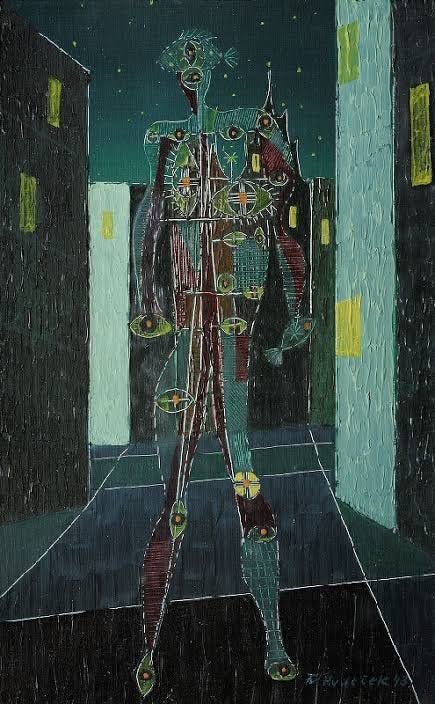
Before the “I” notices, a great deal has already happened. Before I say “I am afraid,” the body may already be in alarm. Before I think “he is judging me,” another person’s face may already have been read as a threat. Before I decide whether I trust someone, my system may already set distance, tension in the voice, the range of the gaze, readiness to defend. Before I name the situation, the organism may already shorten the breath, quicken the heart, pull the shoulders back, sharpen hearing, narrow attention, or prepare words I have not yet spoken.
Consciousness often arrives late. Not as the first cause, but as a later witness, interpreter, narrator, sometimes corrector. Experience seems obviously “mine,” but many of its elements have been prepared before the feeling appears: “now I see this.” This does not mean consciousness is unimportant. It is very important. But it is not the solitary king of the system. It is more like light falling on a fragment of an enormous labor that is already underway.
Underneath, an automatic background is at work.
This background is not a single mechanism. It is not a little hidden person inside a person. It is rather an entire layer of processes that operate quickly, partly outside attention, often without full words and without the need for conscious command. Habits of movement. Automatic associations. Learned predictions. Reading faces and tones. Preparing the body for action. Micro-reactions of fear, shame, approach, withdrawal. What “comes to mind by itself.” What is “immediately obvious.” What we do before we think that we are doing it.
In a certain sense, all life needs this background. If we had to consciously manage every movement, every word, every breath, and every assessment of a situation, we would not be able to survive a single day. We could not walk and talk at the same time. Drive a car and respond to traffic. Recognize a familiar face in a crowd. Respond to a change in tone. Catch a cup before it falls. Read sentences without analyzing every letter. Maintain the rhythm of a conversation without counting every pause. Consciousness is too slow and too narrow to run everything by itself.
That is why the system automates.
What is repeated begins to require less effort. Movement becomes smoother. Reaction faster. Recognition more immediate. When you learn to ride a bicycle, at first everything is conscious and stiff: balance, pedals, handlebars, road, brake. After a while, the body rides. Not because the complexity has disappeared, but because the complexity has been moved into the background. When you learn a language, at first you search for words, and then sentences begin to come. When you learn an instrument, the fingers eventually know more than you could calmly describe.
Automaticity is therefore an economy of life. It allows us not to begin from zero every time. It allows us to use what the system has learned. It allows consciousness to deal with what is new, difficult, ambiguous, or in need of correction. Thanks to the automatic background, a person can have a history of skills, not merely a set of conscious instructions. They can move through the world with an entire infrastructure of learned movements, recognitions, predictions, and shortcuts.
But the same background that helps can also imprison.
The system does not automate only what is good. It automates what is repeated, strong, necessary, or adaptive in a given environment. If for years one had to watch someone’s mood, the automatic background may become a scanner of tension. If mistakes were punished with shame, the background may immediately activate defense against trying. If closeness was unpredictable, the body may pull back before the head has time to say: this person is not that person. If rest was treated as laziness, tension may appear at the very moment of inactivity.
This is one of the most uncomfortable truths about human beings: not everything that works in us waits for our permission.
Sometimes the reaction has already begun before we notice it. Sometimes the word has almost come out. Sometimes the body has already fled with its gaze. Sometimes the voice has already hardened. Sometimes the interpretation has already set the scene: he is attacking, she is pulling away, shame is about to come, I have to defend myself, I must not show weakness. Only afterward does a thought arrive and try to explain it. And very often the thought does not say: “my system has activated an old pattern.” It says: “but this is how it is.”
The automatic background can pretend to be reality. What appears quickly often feels true. If I immediately feel threat, the world seems threatening. If I immediately feel shame, the situation seems shaming. If I immediately feel distrust, the other person seems suspicious. If I immediately feel guilt, my very existence seems like a problem. The speed of a reaction gives it the appearance of obviousness. And obviousness, as we already know, is not always the same as truth.
That is why it is so important to distinguish the first reaction from full recognition.
The first reaction is information. It does not have to be a lie. It should not be dismissed. Sometimes the body really does notice something consciousness has not yet named. Sometimes tension is a wise signal. Sometimes distrust protects. Sometimes a quick assessment saves us. But the first reaction is not a verdict either. It may be an echo. It may be a habit. It may be an old prediction. It may be a reaction to similarity, not to repetition. It may say more about the history of the system than about the present situation.

A person matures, among other things, when they learn to see their own automatisms as automatisms. Not in order to silence them with contempt. Not in order to say to oneself: “I should not react this way.” Rather, in order to recover at least a little space. I can notice: my body is already defending itself. My voice is already becoming hard. My mind is already looking for blame. My attention is already selecting only signals of threat. My system is already predicting abandonment. This does not remove the reaction. But it introduces a difference between “I am the reaction” and “I see the reaction.”
This difference may be small, but it is fundamental.
Because the automatic background works best when it remains completely transparent. When it cannot be seen that it is working. Then a person says: “this is just how I am,” “this is always how it is,” “it cannot be otherwise,” “I have to,” “I cannot,” “it is obvious.” But when the background becomes even slightly visible, a question appears. Is this a current response, or an old map? Is this really this situation, or a similarity to something from the past? Do I have only one possibility, or does my system, for now, see only one? Can I wait one second longer before following the first movement?
This question is not an abstraction. It has a body. Sometimes it means one breath before answering. One step back. Relaxing the hands. Noticing the tightness in the stomach. Naming it: I am activated. Asking for a moment. Checking the tone. Saying: I am not sure I am reading this correctly. Sometimes the whole breakthrough does not consist in a grand transformation, but in the appearance of a minimal pause between stimulus and automatic reaction. In that pause, there is not yet full freedom. But there is the beginning of another movement.
The automatic background also shows why knowledge alone is often not enough. You may know that conflict does not have to mean the end of a relationship, and yet your body may behave as if abandonment were about to happen. You may know that rest is necessary, and yet feel guilt. You may know that not every mistake is a catastrophe, and yet freeze before trying. You may know that someone did not intend to hurt you, and yet hear an attack. Knowledge lives in one layer of the system. Automatic prediction lives in another. A bridge has to be built between them.
That bridge is built slowly.
Through repetition. Through regulation. Through new experiences. Through relationships that end differently from old ones. Through the practice of noticing a reaction before it takes over the whole. Through a body that learns it can survive tension without immediate defense. Through language that allows us to say: “this is old,” “this is alarm,” “this is only the first version.” Through an environment that helps the system not return constantly to the same modes.
Because automatisms do not change through decision alone. A decision can be a beginning. It can direct attention. It can choose a practice. It can say: I want to learn differently. But the decision itself does not rebuild the background immediately. Someone may decide that they will be calmer, and then in the first difficult conversation discover that their nervous system has its own history. Someone may decide that they will trust, and then see that the body does not trust on command. Someone may promise themselves they will not be afraid of judgment, and then feel old shame before they have time to use arguments.
This does not mean decisions are worthless. It only means that a decision has to descend into practice, and practice has to descend into the body. A new way of responding has to be repeated in real situations, not only written down as an idea. The system has to pass many times through small corrections: notice, pause, name, check, choose a little differently. It will not always work. Sometimes the old pattern will win. But even then, learning can continue: what activated me? When did the reaction begin in the body? What was the first signal? What did I need earlier? What smaller pause might be possible next time?
This is how awareness of the automatic background develops. Not through total control, but through noticing earlier and earlier. First, you realize an hour after the reaction: I responded in the old way again. Then after ten minutes. Then during the conversation. Then at the moment when the voice begins to change. Then even earlier: when the stomach tightens, before a sentence appears. This is real change. It does not mean the background disappears. It means it becomes less absolute.
It is also worth seeing that the automatic background is not only private. It is socially created. We learn automatisms in relationships, families, schools, cultures, technologies. We learn whom to yield to. Whom to fear. How quickly to answer. What success means. What failure means. What a “normal” body looks like. When one is allowed to cry. When one has to smile. How to speak to authority. Whom to recognize as “one of us,” and whom as “foreign.” Many reflexes that seem entirely personal are traces of the social world in the body.

This is especially visible in prejudices and judgments. A person may consciously believe in equality, and yet their automatic associations may operate faster than their declarations. They may want to listen, and at the same time more quickly assign credibility to someone who fits a learned image of authority. They may consider themselves open, and still reflexively feel distance toward what is unfamiliar. This is uncomfortable, but very important. Conscious values are necessary, but they do not automatically erase the traces of culture, history, and repeated images.
That is why responsibility does not mean pretending we have no automatisms. It means, rather, examining them, correcting them, and not mindlessly handing power over to them. If the first reaction appears before choice, then responsibility often begins a moment later: what will I do with it? Will I check it? Will I let it write the whole behavior? Will I notice that it is only the system’s first setting? Will I create conditions in which, over time, the background can be rebuilt? We are not responsible for everything that automatically appears in us. But we can gradually take responsibility for how we work with it.
This is more delicate and more honest than simple moralizing. Moralizing says: you should be different immediately. Understanding the system says: see what operates quickly, where it may have come from, how it affects others, and how it can be changed. Not in order to excuse oneself. In order for change to be real. Contempt toward one’s own background usually does not help. Often it only adds another layer of shame, which itself becomes automatic. Attentive responsibility is better: I see that this works in me, and I do not want to pretend it is not there.
The automatic background also works in a positive direction. Not everything automatic is a problem. Tenderness can become automatic. Attentiveness to someone’s fatigue can be a reflex. Good boundaries can, over time, appear more quickly. The ability to apologize can become more available. Returning to the breath can become a habit. Pausing before a sharp word can enter the body. Trust can become easier. Joy can have its pathways. Sensitivity can be not an effort, but a way of being present.
This shows that the goal is not life without automatisms. The goal is rather to shape the background so that it does not constantly work against life. So that some good responses become easier. So that care does not require heroism every time. So that the body does not have to renegotiate every sign of safety from the beginning. So that the world can sometimes be received without immediate defense. So that a person has not only conscious beliefs, but also learned ways of returning to themselves.
This leads us to an important conclusion: character is not only declarations.
Character is also the automatic background trained by repetition. It is what you do when you do not have time for a beautiful theory. How you respond when you are tired. Whether you can stop before you hurt someone. Whether you can return and repair. Whether your body knows the road to a boundary, to care, to courage, to truth. Of course, no one is perfect. Fatigue, stress, and fear bring us back to older layers. But this is precisely why what we practice every day matters, before the difficult moment comes.
In a difficult moment, we often do not rise to the level of our ideals. Rather, we fall to the level of our established patterns.
That is why it matters so much which patterns we feed. What we repeat in relationships. How we speak to ourselves after a mistake. Whether we teach the body pause, or only tension. Whether our environment strengthens distraction, haste, comparison, and alarm, or also offers rhythm, silence, presence, and return. The automatic background does not come from nowhere. It is a history of repeated conditions. And the future of the background depends on what conditions we begin repeating now.
This closes the whole cognitive segment.
We can now look back at the path so far once more, but more deeply. Attention selects, but not always consciously. Perception constructs, but many of its assumptions operate in the background. Affordances show the world as a field of action, but what seems possible is often recognized automatically. Learning reorganizes the system, and much of that reorganization later works without words. Memory binds time, but not every memory is a story. Language gives meaning, but many meanings have been prepared before a sentence appears. Thinking predicts, but its first scenarios often grow out of automatic expectations.
A human being is therefore more complex than the conscious “I.” Not less human because of this. More human. Because this shows that we are layers: a body that reacts; a history that predicts; attention that selects; memory that returns; language that names; thought that simulates; an automatic background that prepares the world before we have time to say “I.” Consciousness does not disappear in this image. It only stops pretending that everything begins with it.
We might put it this way: before a person consciously notices, thinks, and names, their system is already working. It selects, evaluates, compares, predicts, prepares the body, and activates old patterns. This automatic background is necessary, because without it life would be too slow and too heavy. But it is also dangerous if it remains completely invisible, because then old maps can pretend to be reality, and first reactions can pretend to be truth.
Maturity, then, does not mean that everything becomes conscious. That is impossible.
Maturity means rather that a person learns to recognize enough of their own background not to be entirely led by it. That they can sometimes pause at the first reaction and ask: what is operating here? What has my system already assumed? Is this the present, or an old pattern? What is the smallest different movement available?
And this is where our cognitive layer ends. Not because everything has been explained, but because we now have a fuller foundation. A human being is not a passive receiver of the world. They select, construct, recognize possibilities, learn, remember, name, predict, and act against the background of an enormous automatic labor of the system. From the outside, it sometimes looks as though they are simply “reacting.” But beneath the reaction lies an entire history of life, body, environment, and meaning.
Now we can ask about something that can no longer be postponed.
Why do some stimuli, memories, words, possibilities, and thoughts carry weight for us? Why are some things indifferent, while others move us immediately? Why does something attract or repel, soothe or alarm, awaken hope or disgust, shame or tenderness? Why is the same world an invitation for one organism and a threat for another? Why is understanding so often not enough for suffering to subside?
Here the next block begins.
Emotions.
Not as chaos after cognition. Not as an obstacle to reason. Not as an addition to “real” thinking. Emotions are the way the organism marks value, safety, loss, need, and direction for action. They are a compass that can be wrong, but cannot be thrown away without losing orientation.
That is why, after the automatic background, we can go deeper into the question of what moves a human being.
Not only what they see. Not only what they remember. Not only what they think.
But what matters to them enough that the body begins to respond.