

The story of Cyril and Methodius did not end with their deaths or with the expulsion of their disciples from Moravian lands. On the contrary—this moment marked the beginning of an entirely new chapter, one that became a symbol of renewal, preservation of meaning, and the enduring spiritual heritage of the Slavs.
After Methodius’s death in 885, when the disciples of the two brothers were forced to flee Moravia, their spiritual legacy— embodied in the Slavic liturgy and the Glagolitic script—found unexpected refuge in the south of Europe. Fleeing persecution by the German clergy, the disciples—figures like Clement of Ohrid and Nahum—found protection at the court of Tsar Boris I of Bulgaria. A ruler as visionary and ambitious as Rastislav, Boris recognized that embracing the legacy of Cyril and Methodius could strengthen the spiritual and cultural independence of his state.
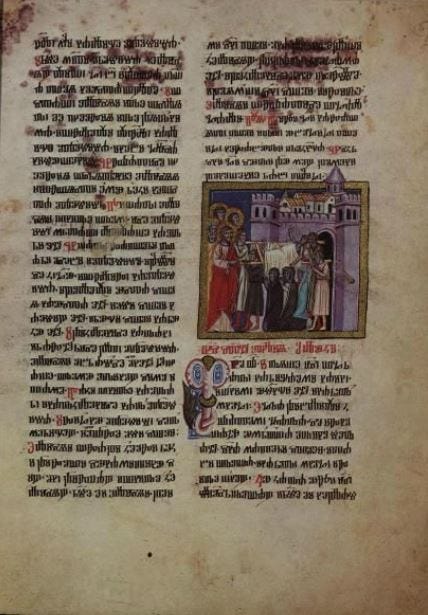
In Bulgaria, the mission not only found favorable political conditions—it was embraced as a spiritual and cultural project of profound identity-building significance. Tsar Boris I provided not only protection but also active support, allowing the disciples to continue and expand the work that had begun in Moravia. One of the first major literary schools was established in Ohrid, where Old Church Slavonic could continue to develop, deepen, and take root in the spiritual culture of the southern Slavs. There, in the heart of the Balkans, the spiritual message of Cyril and Methodius found fertile ground to grow and flourish for centuries to come.
Symbolically, this meant the salvation of the mission’s meaning—what had been rejected in the West was gratefully received in the South, and given new strength and permanence. Old Church Slavonic and the Glagolitic script—although later replaced by the simpler Cyrillic—became not only the language of liturgy, but also of literature, art, poetry, and philosophy. In doing so, they became central elements of the cultural and spiritual identity of the southern Slavs.
This transference of spiritual heritage from West to South carried deep symbolic weight. Glagolitic and the Slavic liturgy did not become tools of expansion. On the contrary—they became symbols of spiritual preservation, the survival of an idea that could have vanished entirely. This preservation was not merely linguistic or cultural—it was spiritual. It was the safeguarding and continuation of the inner potential that lay at the heart of the Cyrillo-Methodian project. The South of Europe became a kind of spiritual “repository” for the Slavic experience of the sacred—a place where it could endure, regardless of political upheavals or historical catastrophes.
Over the centuries, thanks to this shift, the Balkans—especially present-day Bulgaria, North Macedonia, and Serbia—became a center of Slavic spirituality. The writing system, liturgy, and religious and philosophical literature not only survived, but grew to impressive proportions, influencing the entire Slavic world— including Kievan Rus, and later, Russia. Paradoxically, the rejection of the Slavic liturgy in the West contributed to its deepening, expansion, and lasting entrenchment in the South and East.
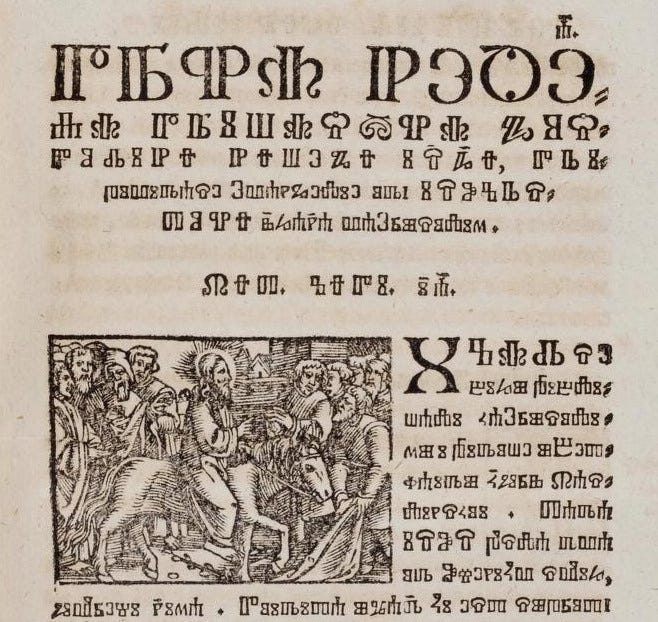
The spiritual and cultural history of the southern Slavs thus became a story of a recovered voice—a voice lost in Moravia, but fully restored in Ohrid, Preslav, and later in the monasteries of Mount Athos. For modern-day Slavs, the symbolism of this event remains profoundly meaningful—it is a reminder of the importance of spiritual and cultural autonomy, of the truth that the sacred cannot be imposed from the outside, but must arise from the authentic experience of a people.
Ultimately, it is in this preservation of meaning that the true strength of Cyril and Methodius’s mission resides. Their spiritual message survived not because it was enforced, but because it found places, people, and cultures willing to receive it, nurture it, and let it grow. The South of Europe became a spiritual home for the Slavic liturgy—a refuge, a place where it could not only survive but also f lourish, even to this day.
For people today, this is also a reminder of how vital it is to care for one’s own spiritual identity—because even the most fragile ideas can endure, if only they find the right space, the right moment, and the right hearts ready to preserve them.
This fragment comes from my work-in-progress book. As I move forward with the project, I plan to share various pieces of it to give readers a glimpse into the world I’m creating. If you enjoy this material, you can access the current version of the book through a paid subscription. And if you feel drawn to the project and would like to help shape its future, I’d be delighted to collaborate with you. :)