

The Glagolitic alphabet is difficult to describe as merely a tool for writing. At first glance, its letters differ fundamentally from the forms familiar in the Latin or Greek worlds. These are not merely signs of sounds—they are figures. Geometric forms, symbols, at times even ornaments that do not merely represent but express. This alphabet seems to speak not only to the mind, but to the eye, the body, and the intuition.
Each Glagolitic letter is the result of deliberate design—crafted with attention to rhythm, direction, and proportion. Some characters seem rooted in Byzantine aesthetics; others resemble magical signs, spirals, crosses, or circles. Despite its apparent foreignness, Glagolitic is visually coherent—as if each element belongs to a larger, hidden order.
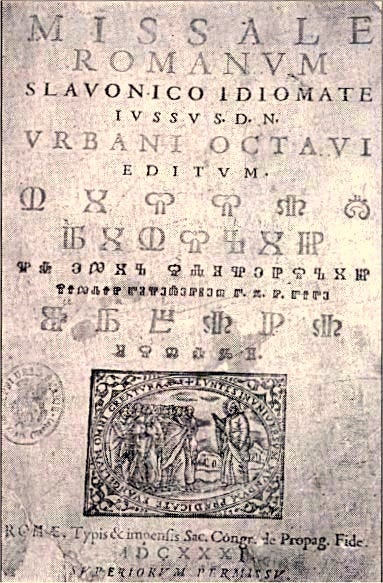
Contemporary scholars note that in creating Glagolitic, Constantine (Cyril) may have drawn inspiration not only from Greek, but also from Hebrew, Coptic, Syriac, and perhaps even mystical geometric symbolism. Constantine was not only a philosopher and polyglot, but also a deeply spiritual man whose work went beyond philology. As a creation, Glagolitic transcends functionality—it is a testament to spiritual imagination suspended between logic and revelation.
Furthermore, Glagolitic letters also carry numerical values— much like in the Greek and Hebrew systems. This alphabet may therefore have been used not only for writing but also in numerological systems, or perhaps even as a matrix of spiritual order where sound, sign, and number interweave. Such an approach is atypical for ordinary writing systems—but natural within symbolic systems such as the Hebrew alphabet (gematria) or the runes.
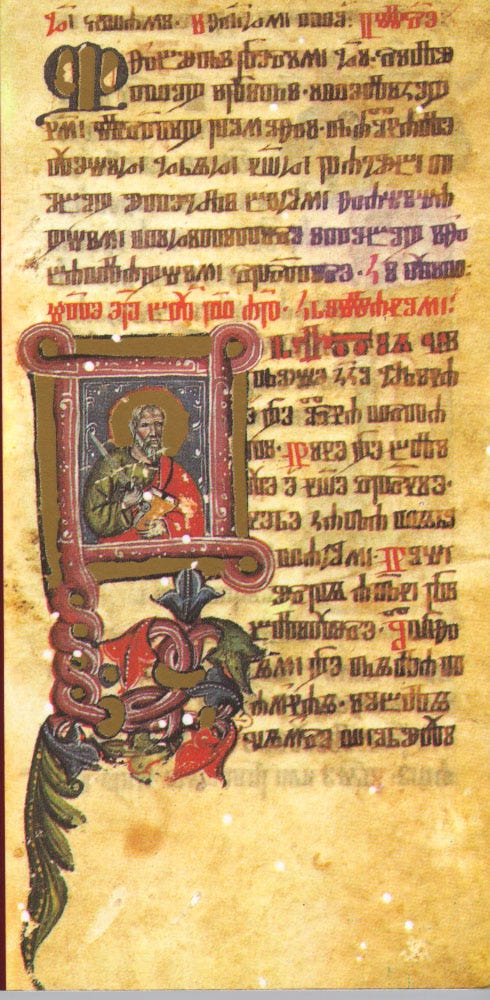
The artistic dimension of Glagolitic must also not be overlooked. It was not merely a tool of communication—it was an object of contemplation. Manuscripts written in this script often exhibit extraordinary beauty: ornate initials, rhythmic text layout, graphic accents. Glagolitic was not only meant to be read—it was meant to be seen, felt, and experienced. In this sense, it was not just an alphabet, but an icon—a form of visual prayer.
Seen through this lens, Glagolitic becomes something far greater than a system for recording sound: it is a map of ideas, a collection of archetypes, an alphabet of the soul. In each letter, one can perceive the tension between form and meaning, between the sign and the space that surrounds it. Perhaps this is precisely why it has endured—not as an everyday script, but as a sacred sign, a vessel of inner potential, a bridge between what can be spoken and what can only be intuited.
This fragment comes from my work-in-progress book. As I move forward with the project, I plan to share various pieces of it to give readers a glimpse into the world I’m creating. If you enjoy this material, you can access the current version of the book through a paid subscription. And if you feel drawn to the project and would like to help shape its future, I’d be delighted to collaborate with you. :)