

Glagolitic, the oldest known Slavic alphabet, is a construct that fascinates not only for its linguistic significance but also for its aesthetic and structural qualities. Its creator, Constantine (later known as Cyril), did not design this script by accident. Linguistic and historical research clearly indicates that Glagolitic was the result of intentional design—one that addressed the phonetic needs of the Slavic language, while also honoring the script’s aesthetic and sacred functions.
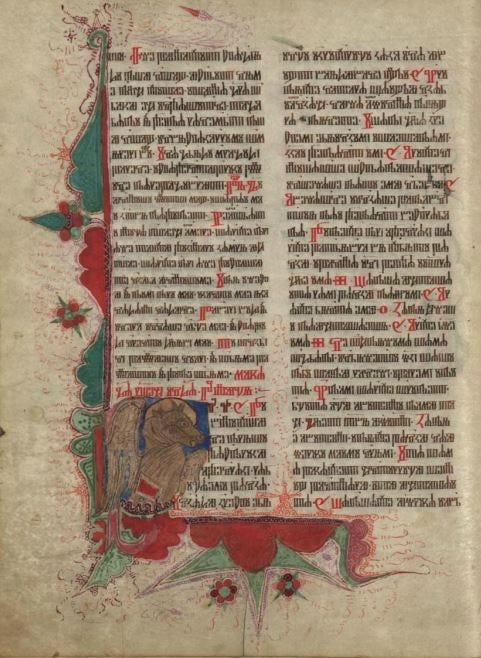
Although there is no conclusive scholarly evidence that each letter was assigned symbolic or esoteric meaning, the very form of Glagolitic seems to go beyond mere phonetic utility. Historians of writing have noted that many of its letters exhibit a distinctly geometric and ritualistic character—often incorporating crosses, circles, or triangular structures—suggesting a deeper liturgical significance. Some scholars propose that Constantine, being well versed in logic, theology, and Semitic languages, may have deliberately crafted these signs to imbue them with visual dignity, f itting their sacred purpose.
It is also noteworthy that, like the Greek and Hebrew alphabets, Glagolitic assigned numerical values to its letters. This allowed the script to be used not only for writing but also for numbering liturgical texts and formal documents. While there is no known evidence of a fully developed numerological system based on Glagolitic, its very structure made such a system conceivable— an idea that continues to intrigue philologists and intellectual historians alike.
Today, various academic and cultural circles continue to explore potential symbolic interpretations of Glagolitic letters. Though most of these analyses remain within the realm of speculative semiotics or cultural hermeneutics, their very existence reflects how Glagolitic is viewed not merely as a linguistic relic, but as a vessel of deeper historical and spiritual meaning. Particularly intriguing are studies linking the structure of its letters to Slavic conceptions of the world—characterized by cycles, dualities, the sacralization of nature, and a worldview rooted in sound, rhythm, and repetition.
The point is not to impose meanings on Glagolitic that it may never have had—but rather, to recognize it as a meeting point between two systems: the emerging Christian spirituality of the Slavs and their pre-Christian traditions, in which the world was understood through language, rhythm, image, and ritual repetition. In Glagolitic—as a liturgical form—we witness a convergence of the universal and the local, the revealed and the cultural, the logical and the symbolic.

From this perspective, Glagolitic becomes “mystical” not in an esoteric sense, but in a cultural-transcendental one: a form of writing that not only conveys content but also shapes the way that content is received. It was—and perhaps can be again—a space where the sign does not end with the letter, but begins a journey toward meaning.
This fragment comes from my work-in-progress book. As I move forward with the project, I plan to share various pieces of it to give readers a glimpse into the world I’m creating. If you enjoy this material, you can access the current version of the book through a paid subscription. And if you feel drawn to the project and would like to help shape its future, I’d be delighted to collaborate with you. :)