

In First Rules in Motion, I focused on the pieces: how they move, how their roles interact, and how the board can help explain those relationships.
That playable prototype was already there. What has grown around it is the application itself.
Knyaz now has a fuller path from opening the game to preparing a match, playing, seeing the result, and starting again. There are computer opponents to practise against, different local configurations to explore, and a working foundation for private online duels. The game in its current state is available at knyaz.online
The project is still in development. But it has reached a point where I can show more than isolated mechanics. I can show the experience taking shape around them.
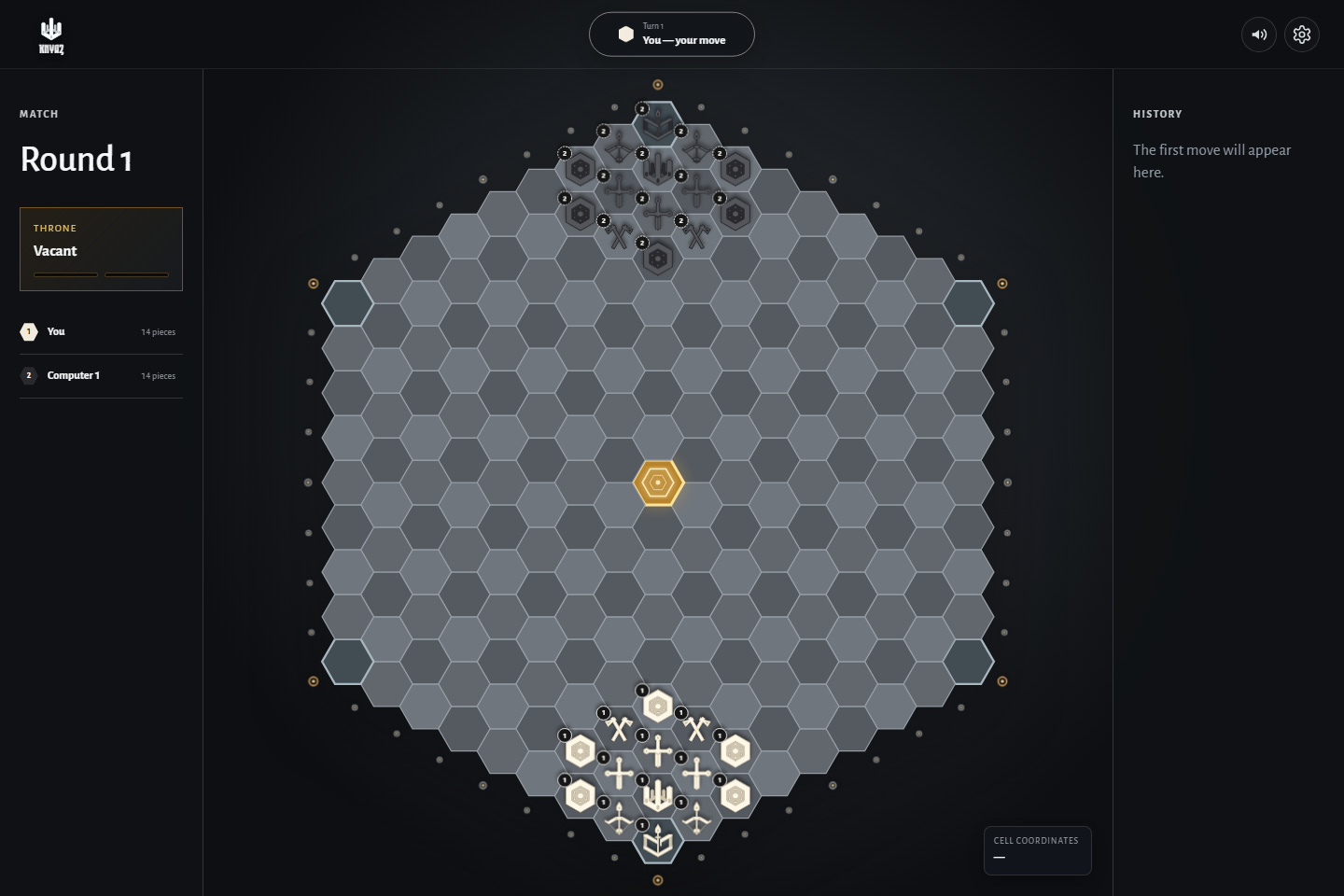
A game begins before the first move
A rules prototype can begin with a board and a reset button. An application needs to help someone arrive at that board.
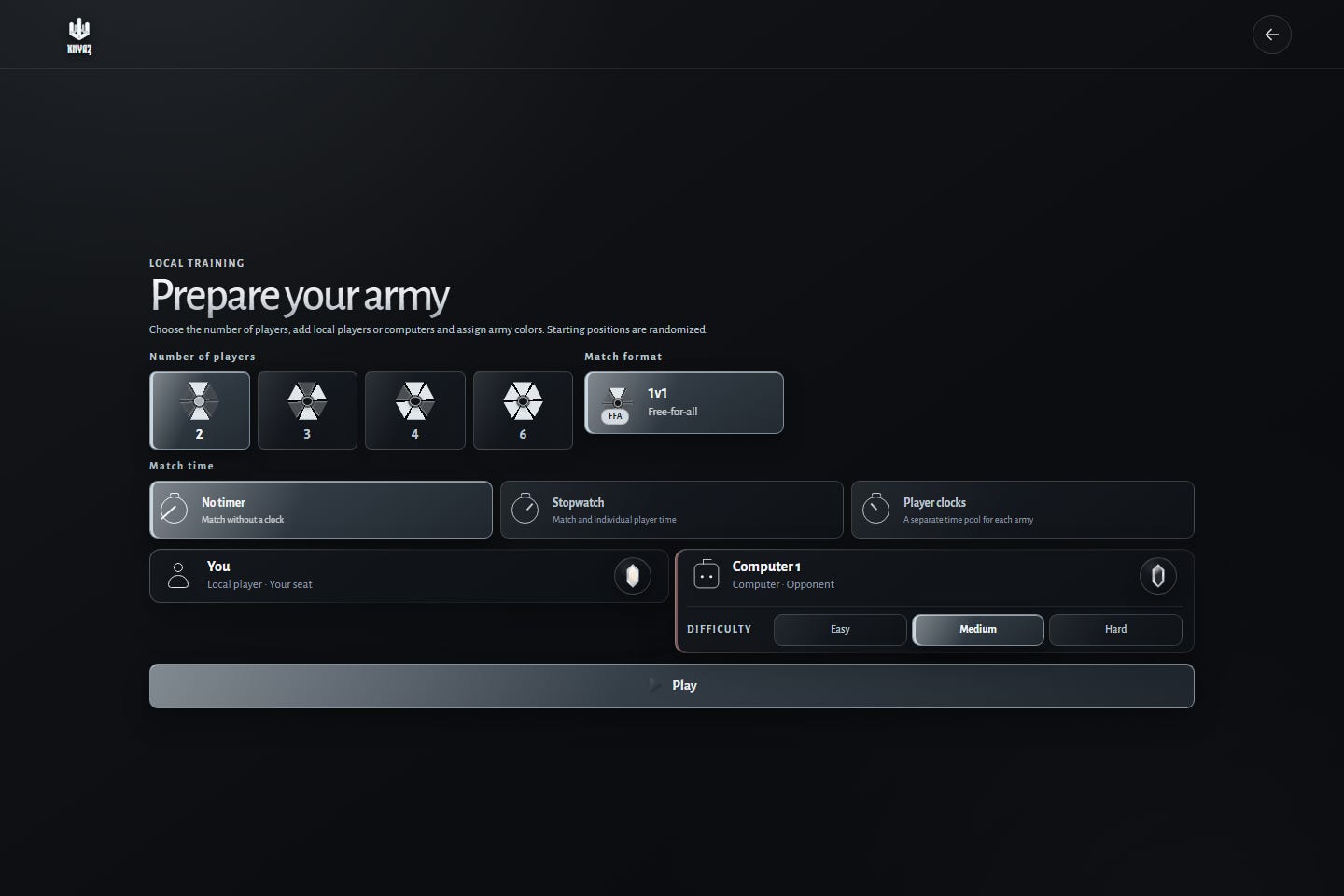
There is now a dedicated home screen, a choice of play modes, and a setup screen where the shape of a local match becomes explicit. The supported player counts are two, three, four, and six. Depending on the configuration, the game offers free-for-all or team arrangements.
Local seats can be filled by people or computer opponents. Players can choose army colors and decide whether to play without a timer, measure elapsed time, or use individual player clocks.
These choices make testing much more practical. I can return to a duel to examine a particular interaction, then move to a larger game and see how the same pieces behave under pressure from several directions.
Having someone to practise against
Computer opponents are now part of local training, with Easy, Medium, and Hard settings.
That gives the project something it needs: a way to keep playing between sessions with other people. A position can be explored immediately. Different setups can be tried without gathering a full table every time.
It also changes the work of development. When a game can answer back, weaknesses become easier to notice. A rule may function correctly while still producing an awkward rhythm. A legal move may be difficult to recognize. A formation may feel convincing until another army starts taking it apart.
The current AI is a tool for practice and testing. Its presence does not settle the question of balance, and the difficulty labels still need the evidence of more play.
Making the position readable
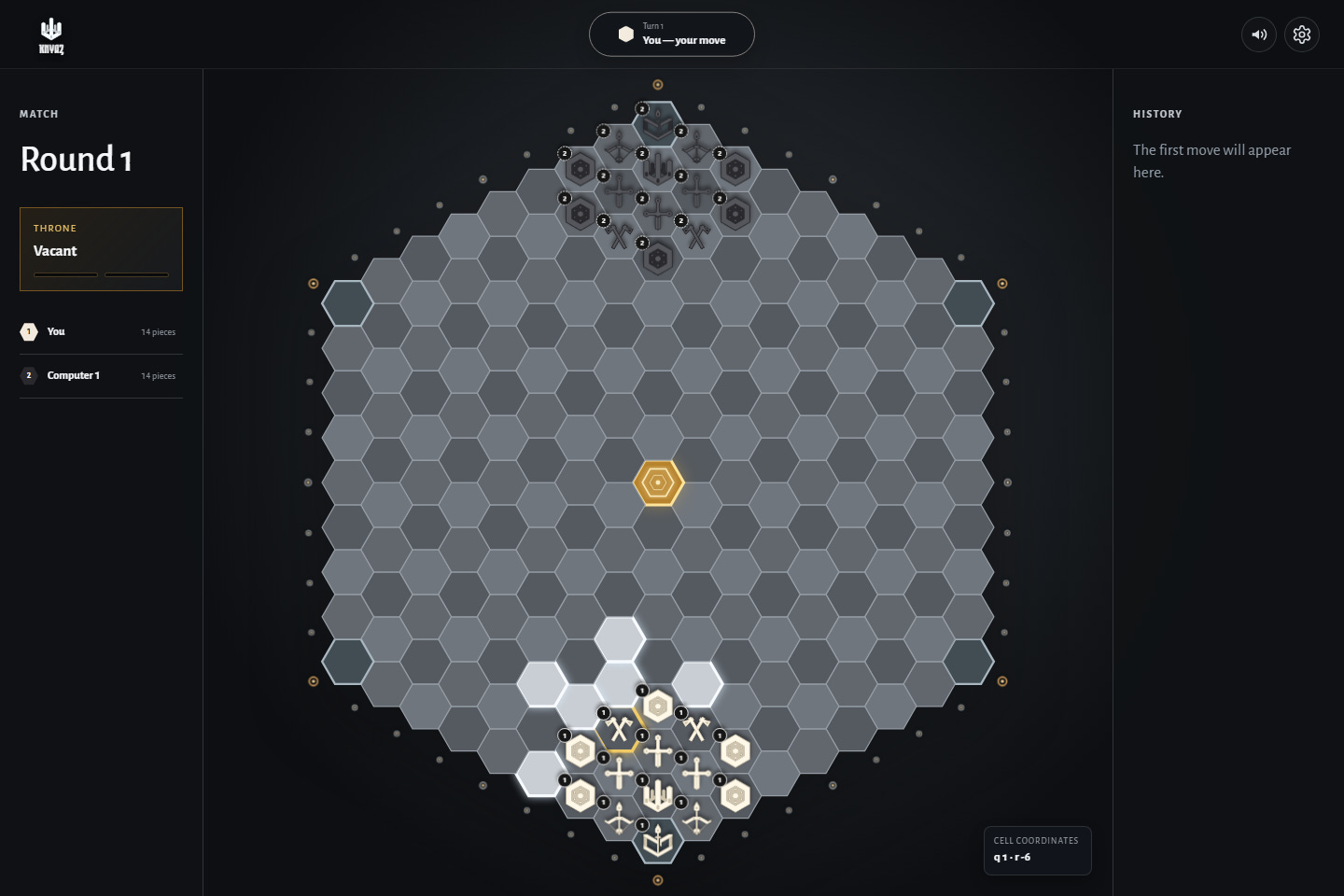
The board is now surrounded by the information needed to follow a match: whose turn it is, the state of the Throne, the remaining armies, and a history of actions.
Legal-move highlights and tactical hints can be controlled separately. Coordinate guides can be hidden or displayed as dots or numbers. Local players can use board rotation to make passing turns more comfortable.
I like this direction because different players need different amounts of help. Someone learning the pieces may want more guidance. Someone familiar with them may prefer a quieter board.
The interface has to support both without changing the game underneath.
Giving Knyaz a consistent atmosphere
The application now has three visual themes: Dark, Light, and Bronze. Music and sound effects have separate controls, and animations can be reduced.
The interface also supports ten languages: English, Polish, German, French, Spanish, Russian, Simplified Chinese, Norwegian Bokmål, Esperanto, and Interslavic. Interslavic can be displayed in either Latin or Cyrillic script.
That last detail feels particularly appropriate for Knyaz. Its names and imagery grow from a Slavic frame of reference, while the game itself should remain approachable to people who arrive from elsewhere.
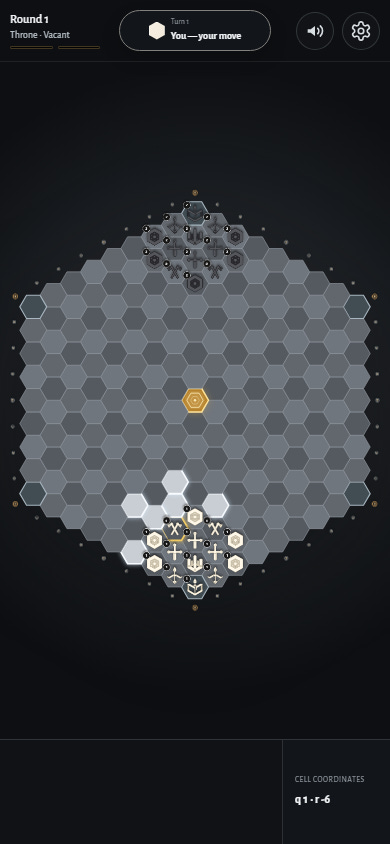
These features bring their own work. A translated button has to fit. A symbol has to remain legible in another theme. Sound has to communicate without becoming tiring. The smaller screen has to retain enough space for the board.
The first step beyond one screen
One of the largest changes sits behind a relatively simple idea: create a private room, share its code, and play a duel from separate devices.
That online foundation is working in the test environment. It uses guest sessions and private rooms, with the server deciding which actions are valid and keeping the official match state and clock.
The less visible work matters here. The application supports reconnecting after a lost connection or refresh. Match data is stored so that a server restart does not simply erase the game. Recovery behavior has been exercised with two independent clients, including a controlled restart.
This is still an early, invitation-based testing stage. Private online 1v1 is the implemented scope; the larger local formats should not be read as a promise that every format is already available online.
The next evidence needs to come from people using it: joining rooms, switching between screens, losing connections, returning, and discovering where the experience still feels uncertain.
What comes next
The priority now is to make this foundation dependable through more playtesting, stronger computer opposition, continued work on accessibility, and hands-on checks across browsers and real phones.
There are also questions that no interface can answer by itself. Does a match sustain tension? Do the different armies have enough room to act? Are the team formats interesting over repeated games? Does a new player understand what happened when they lose?
Those are the questions I want the next stage to expose.
Knyaz has a board, pieces, and rules. Increasingly, it also has the surrounding structure that lets someone sit down, make choices, and play.
That is the progress I wanted to share this time: the game is becoming easier to enter, easier to test, and ready for a wider conversation through play.