

Glagolitic script is more than just writing. It is a sign. An archetype. An echo of a decision to speak to people in their own language—not only through words, but through form, rhythm, and rootedness. This alphabet emerged in the 9th century as the fruit of a mission by brothers Cyril and Methodius, who—acting at the request of Prince Rastislav—arrived in Moravia with a desire to let Christian liturgy resound in the Slavic tongue. In that gesture, there was more than politics or pedagogy: there was a belief that the sacred should dwell where thought is born—in the soul of a people, in the sound of their speech, in the shape of their signs.
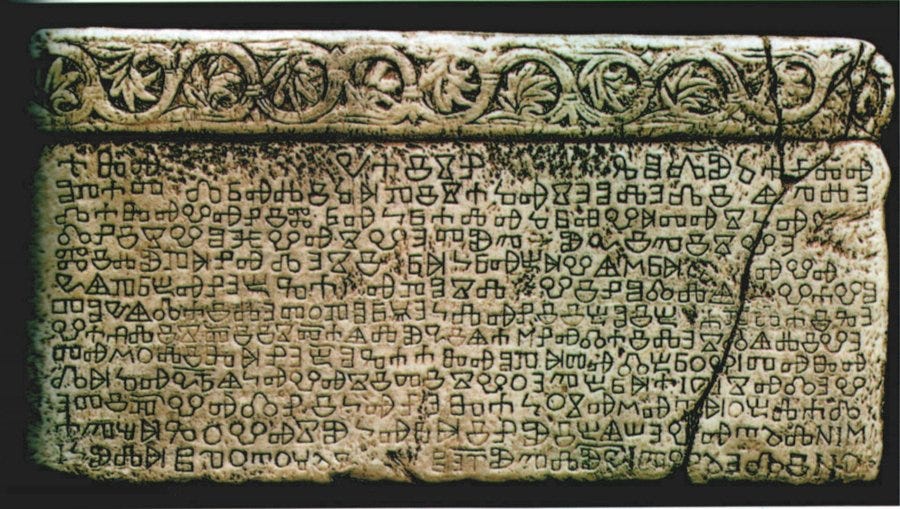
Constructed from deliberate geometric forms, Glagolitic was not merely a practical writing tool. It was a cultural creation—rooted in the Slavic world of imagination. Its creators did not merely transcribe sounds—they shaped symbols meant to carry spiritual meaning: harmony, rhythm, numerological significance, symbolic order. There is strong reason to believe that this alphabet was meant to hold not only pragmatic value, but initiatory power—to convey the structure of the world in visual form, accessible to the soul through meditative engagement with shape and sound.
The relationship between Glagolitic and Cyrillic is complex—though Cyrillic would go on to dominate the Eastern Christian world, Glagolitic came first, and was subtler. It was the alphabet of mystics and liturgists. Its presence in the liturgy—especially among Croatian and South Slavic communities—endured for centuries, gaining an almost sacred status. Today, we often view it as a curiosity—but it was once the gateway through which not only faith, but the symbolic thought of the Slavs, passed.
The piece you will be reading are not an attempt at reconstruction, nor a spiritual manifesto. Rather, it is a sketch—artistic and introspective—that explores what remains when we brush off the historical dust from a letter and see it instead as a mirror. Each bukva can be a sign—not only phonetic, but psychic, spiritual, archetypal. Just as in systems like the Tarot, I Ching, or runes, the symbol does not “predict,” but evokes meaning. It draws us into contact with something deeper, quieter, less obvious within ourselves.
In this sense, Glagolitic may be approached as a meditative, divinatory, or even therapeutic system. Science is paying increasing attention to such phenomena—recognizing that symbols with a high degree of abstraction and randomness can serve as mirrors of the subconscious. Not because they “work magically,” but because they work inwardly—through meaning, imagination, intuition. And that, in truth, may be more transformative than the most precise data.
This is an invitation. To attentiveness. To the contemplation of the sign. To a quiet, symbolic conversation with your own awareness. I offer no revealed truths. But I offer an alphabet—one that may speak, if you choose to listen with more than just your eyes.
This fragment comes from my work-in-progress book. As I move forward with the project, I plan to share various pieces of it to give readers a glimpse into the world I’m creating. If you enjoy this material, you can access the current version of the book through a paid subscription. And if you feel drawn to the project and would like to help shape its future, I’d be delighted to collaborate with you. :)