

After working through figures like Domovik, Polevik and others, I started to feel a very specific absence inside the world. Not a missing creature in the sense of taxonomy, but a missing kind of presence. Up to this point, the beings I’ve been building carried fairly clear directional energy. Domovik belongs to the interior, to the house, to warmth, repetition, and memory. Polevik stretches outward into the fields, into exposure, labor, and risk. Even when they remain ambiguous, their logic is grounded in space. But something was still missing at the threshold—not the doorway exactly, and not the fence either, but something closer to the ground, softer, quieter, something that belongs to the edge of the cultivated world without fully submitting to it. That is where Bzionka begins.
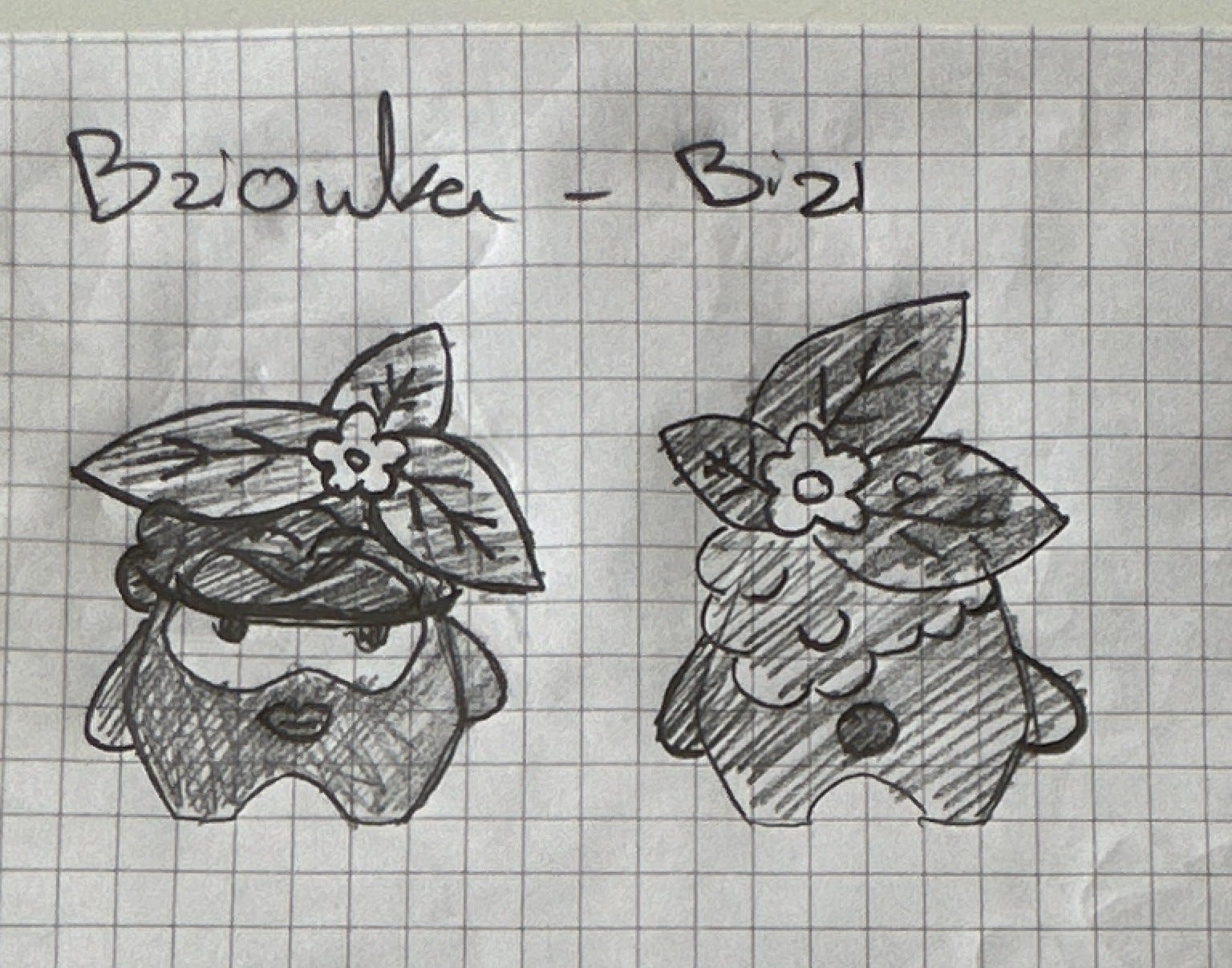
Unlike Domovik, this figure does not come with a stable, well-documented body of sources. Bzionek, in the materials that exist, appears only briefly and inconsistently—sometimes described as a small protective spirit, sometimes as a forest demon associated with the household and, more specifically, with the elder tree. The references are scattered, often secondary, sometimes reinterpreted in modern regional projects. But that instability turned out to be useful rather than limiting. When a figure is not visually fixed, what becomes visible instead is its function. And in this case, that function is surprisingly consistent: protection, proximity to the home, a bond with the elder, and a role in warding off illness, misfortune, or harmful forces.
At some point it became clear to me that this was not a figure built around threat. And that mattered, because in folk demonology “demon” is not a simple moral category. Alongside harmful beings, there are also protective ones—domestic, boundary-bound, responsive rather than aggressive. Bzionek belongs to that group. And that made the figure immediately relevant for Uboże, which until now had begun to accumulate weight on the side of tension and unease. What was missing was not softness exactly, but a different kind of force—one that protects without becoming harmless, one that stabilizes without disappearing into sentiment.
That was also the moment when Bzionek stopped being Bzionek. The shift toward a female figure did not come from a need to artificially balance the collection, even if that balance was indeed lacking. It came from the material itself. The elder tree is not neutral in folk belief. It carries a dense symbolic field: healing, protection, but also death, transition, and contact with what lies beyond. It stands very close to the house, yet is never entirely safe to disturb. It protects, but it demands respect. It is medicinal, but also liminal. That combination suggested a different kind of presence—not fully domestic like Domovik, not fully external like Polevik, but something in between, closer to the body, closer to illness and recovery, closer to the fragile boundary between life and death. Translating that into a feminine form felt less like a design decision and more like a consequence of that logic. That intuition was reinforced by the fact that herbal knowledge among the Slavs was often associated with women, making the feminine turn feel culturally resonant as well as symbolically coherent. And, on a more personal note, there was also a quieter impulse behind it: my partner loves elder—especially its scent—so this figure became, in some small way, a gesture in her direction too.

From the beginning, I wanted to avoid turning the elder into a decorative motif. In many contemporary interpretations, plants are reduced to visual accessories—something added on top of a character rather than something that defines it. Here that would completely miss the point. The elder is not an addition; it is the condition of the figure’s existence. In folk practice it was treated with a kind of cautious reverence. It was planted near homes, used in healing, approached with ritual gestures, associated with both protection and passage. So Bzionka could not simply wear the elder. She had to emerge from it. That is why the leaves began to function as something between a covering and a shelter, the flower became central, almost like a mark or seal, and the darker berry tones introduced a second layer—something less immediately readable as purely alive, something closer to depth, shadow, and weight.
The early visual attempts were mostly about avoiding the obvious. It would have been easy to push the design too far in either direction—toward something overtly dark and supernatural, or toward something soft and decorative. Neither felt right. Instead, the form gradually moved toward stillness and weight. Bzionka does not need to act in a dramatic way. She does not chase anything away. She remains. That decision shaped the entire silhouette. The proportions became more compact, more grounded, less expressive in a conventional sense. Her presence comes from position rather than movement. She sits at the edge of the cultivated space—near the garden, near the boundary, near the place where the human order thins out. That position carries meaning on its own. She is not inside, but she is not outside either. She watches the place where things cross.
What I find most interesting about her is that her character does not emerge from narrative action but from that placement. She is not aggressive, but she is not passive. Not warm in the domestic sense, but not hostile. She is attentive, and in this context attention itself becomes a form of power. That is also why I did not want to over-define her expression or exaggerate her features. The figure works best when it feels stable, grounded, almost quiet—something that does not need to announce itself in order to be effective.
As with the other figures in this series, I am not trying to reconstruct a historically fixed being. Bzionka is not a direct ethnographic recovery. She is built from a small, unstable cluster of references: a regional spirit, a connection to the elder tree, a protective function, and a presence near the household. Everything beyond that—the form, the gender, the tone—is interpretation. But it is an interpretation that tries to remain answerable to the underlying structure rather than to any single visual description.

With her, something in the world of Uboże finally settles into place. She introduces a kind of protection that is neither internal nor external, but tied to the boundary itself. She brings in associations that were not fully present before: illness, care, restraint, respect for what grows close to the home but does not belong entirely to it. And she shifts the balance of the collection—not by softening it, but by deepening it. Because not every force in this world needs to move, confront, or demand attention. Some of them simply remain where they are, holding the line in ways that are not immediately visible.