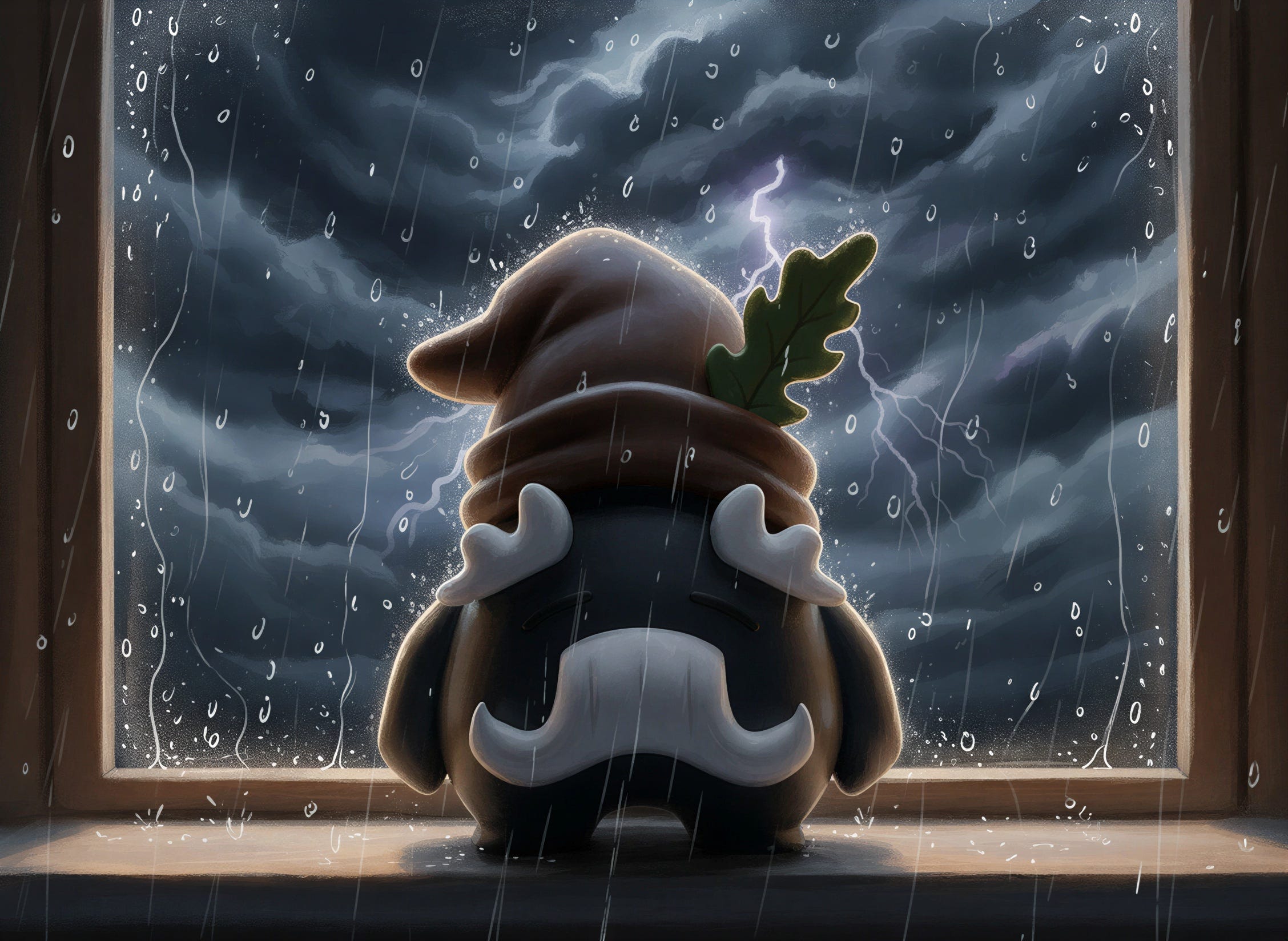
For some time now I have been trying to understand what kind of presence a house spirit should have inside this world.
Not simply what it should look like, but what kind of logic it should carry. What kind of weight. What kind of relationship it should have to the house, to the people inside it, and to the atmosphere of the world around it.
Because once a figure like that appears, it is never only a design problem. It is also a question of tone.
And in a world like Ubože, tone matters from the very beginning.
If I wanted to approach this in the strictest possible ethnographic way, I probably would have begun elsewhere. Domovik, as such, belongs most clearly to the East Slavic sphere: to the figure more commonly described in scholarship as the domovoy or domovyk, a house spirit tied to the household itself. In standard reference and ethnographic accounts, this being is associated with the stove, the hearth, the threshold, the inner life of the home, and even with older layers of ancestor worship. Polish materials do preserve related household-spirit traditions, especially in eastern borderland contexts, but the domowoj/domovik type enters that space through a recognizably Eastern Slavic background rather than as a universally stable Polish household figure.
That distinction mattered to me from the start, because I did not want to pretend I was reconstructing something purely “original” or purely “national” in a neat and uncomplicated sense. I am not doing reconstruction here. I am building a world. And worldbuilding, at least for me, becomes more honest when it admits the distance between source and form instead of trying to hide it.
This is also why I kept Ubože as the main name of the project.
There is a specifically Polish history of naming domestic spirits, and historical research shows that these names did not remain stable over time. Terms that once referred to protective household beings later drifted, in early modern usage, toward meanings closer to a genie or even a devil. That semantic instability is part of what makes this terrain so interesting to me. It means that the old domestic figure was never fully fixed. It moved. It was reinterpreted. It became heavier in some contexts and gentler in others. And that gives me room to treat Ubože not as a museum label, but as the tonal center of the world itself.
Within that world, however, I wanted one figure to be more directly bound to the house.
That is where Domovik begins to make sense for me.
Not as a perfect equivalent to every Polish domestic spirit, and not as a claim that all these traditions are interchangeable, but as a more precise household presence: a being tied to the interior, to habitation, to order, to proximity, to the moral and emotional weather of a home. That is an inference I am making from the overlap of the sources rather than a one-to-one historical equation, and I think it is better to say that openly.
What I find especially useful in the scholarship is that it does not really give us one single, final image of Domovik.
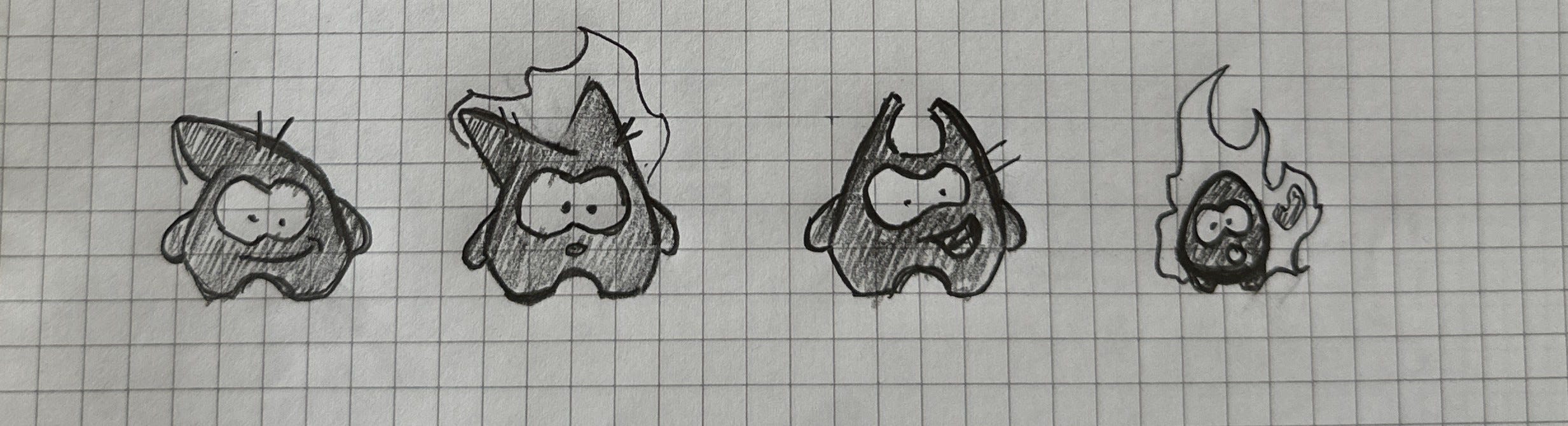
It gives us something better than that.
It gives us a field of recurring functions.
Across sources, the house spirit is less a fixed illustration and more a stable cluster of relations: it belongs to the house, it guards the family and its wealth, it reacts to disorder, it marks the threshold between safety and disturbance, and it often appears not as a fully visible creature but as a presence signaled by knocks, sounds, moods, warnings, or small disturbances in domestic life. Regional studies from Ukraine also show that the image is not uniform; the domovyk can be described differently from place to place, with different emphases placed on appearance, function, ritual practice, and moral character.
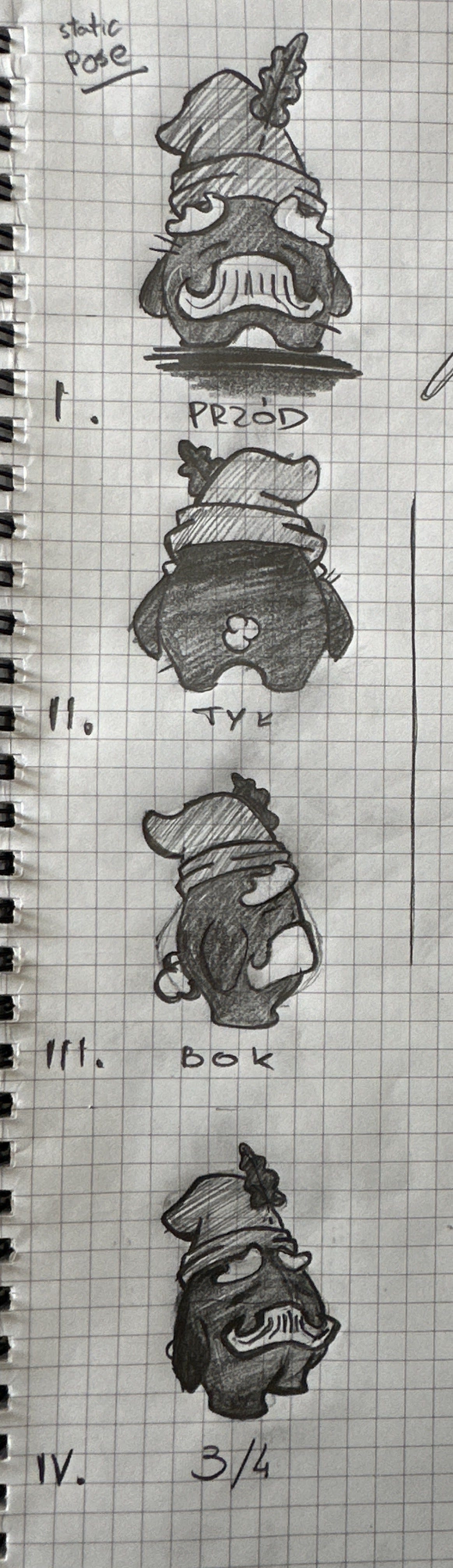
That, to me, is the crucial point.
The figure is not strong because it is visually standardized.
It is strong because it holds together a set of meanings: house, warmth, continuity, vigilance, memory, habit, protection, mood. Even the more familiar descriptions of the domovyk as a small, hairy man living near the stove are less important to me as literal instructions than as traces of a deeper pattern: this is a being that belongs where the house is most alive, most inhabited, most shared.
And once I understood that, the visual decisions became easier.
It meant I did not need to chase a falsely “correct” reconstruction of a folkloric creature.
I did not need to produce an illustration that merely says: old man, beard, hut, folklore. I could instead ask a different question: what visual language makes a figure feel truly domestic, slightly uncanny, protective, old, compact, and memorable all at once? What kind of silhouette belongs to a being that is small enough to disappear into a corner, but strong enough to define the feeling of a house?
This is where my own version begins to separate itself from the archive while still remaining answerable to it.

The Domovik I am building for Ubože does not need to look like a direct ethnographic recovery. He needs to retain the house-bound logic of the older figure. He needs to feel as though he comes from the interior of a home rather than from the outside world. He should carry warmth, secrecy, and a slightly stubborn dignity. He should feel ancient, but not monumental. Familiar, but not entirely harmless. Not evil, but not empty of force either.
That ambiguity is important, because the sources themselves do not give us a purely sentimental creature. The domovoy/domovyk protects, but he also judges. He rewards proper order and can react badly to neglect or offense. In some regional material, the image even becomes more ambivalent or openly dark under later Christian reinterpretations. So the figure is never just “cute.” It is intimate, but intimacy is not the same thing as softness.
There is another reason I do not want to over-literalize him.
The broader Slavic and Balkan material shows just how fluid the role of household guardian can become. In some Balkan traditions, that domestic protector is not imagined primarily as a small old man at all, but as a serpent bound to the house and the family line. For me that is a very useful reminder: the deepest layer of the figure is not one single body shape. The deepest layer is the bond between spirit and dwelling. The house comes first. The visible form comes later.
So in Ubože, Domovik becomes the principal household being not because I need him to stand in for every Slavic domestic spirit, but because he gives me the clearest way to hold several things together at once.
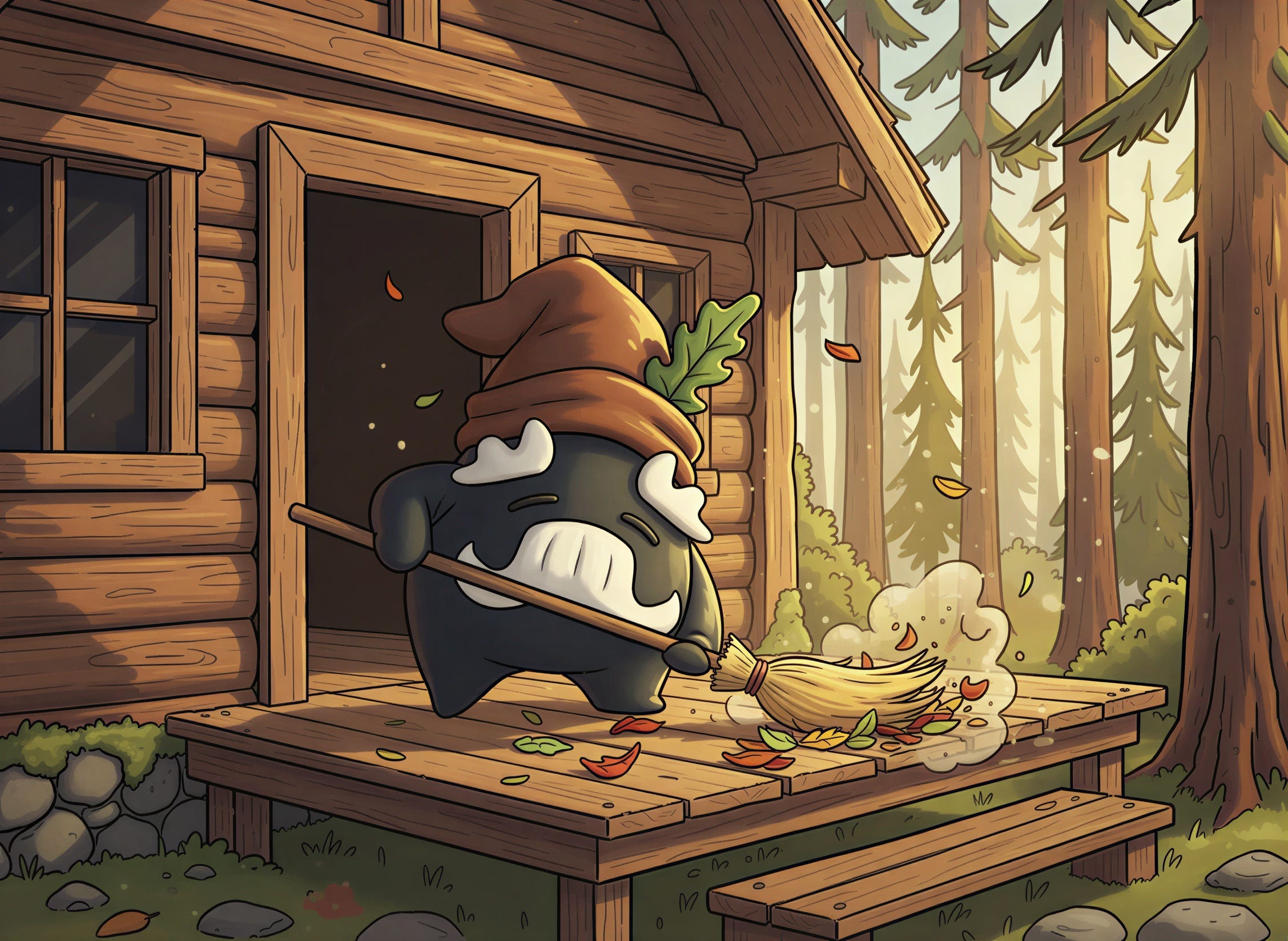
He allows the house to become a living place rather than a neutral setting.
He allows domestic space to have its own psychology.
He allows humor and strangeness to coexist.
And he allows me to place one figure exactly where I want him: close to the home itself, close to its rhythm, close to the things that gather around everyday life without ever fully becoming visible inside it.
That is also why I kept the world’s title as Ubože while letting Domovik settle more specifically into the role of the house-bound being within it. Ubože remains, for me, the broader tone: the wider field, the name that holds the atmosphere of the project. Domovik, by contrast, becomes more local, more interior, more precise. Less the name of the whole world than one of its key domestic intelligences.
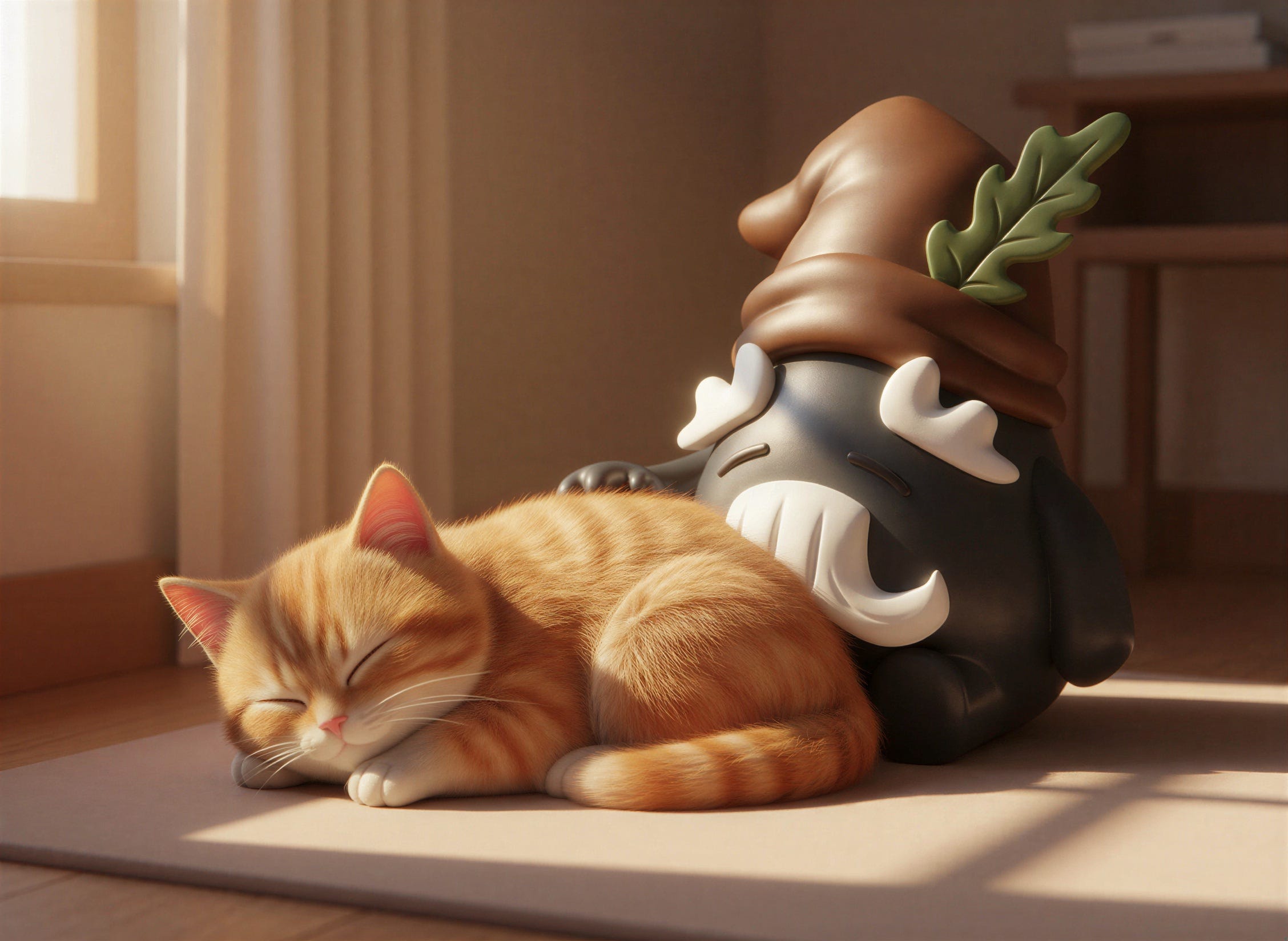
The images throughout this post follow that process from sketch toward a more resolved figure. Not because the final answer has already been found, but because each stage makes the next decision slightly more visible.
That is usually how these things reveal themselves anyway.
Not all at once, and not in a straight line.
First as a tone.
Then as a relation.
And only after that, as a character.