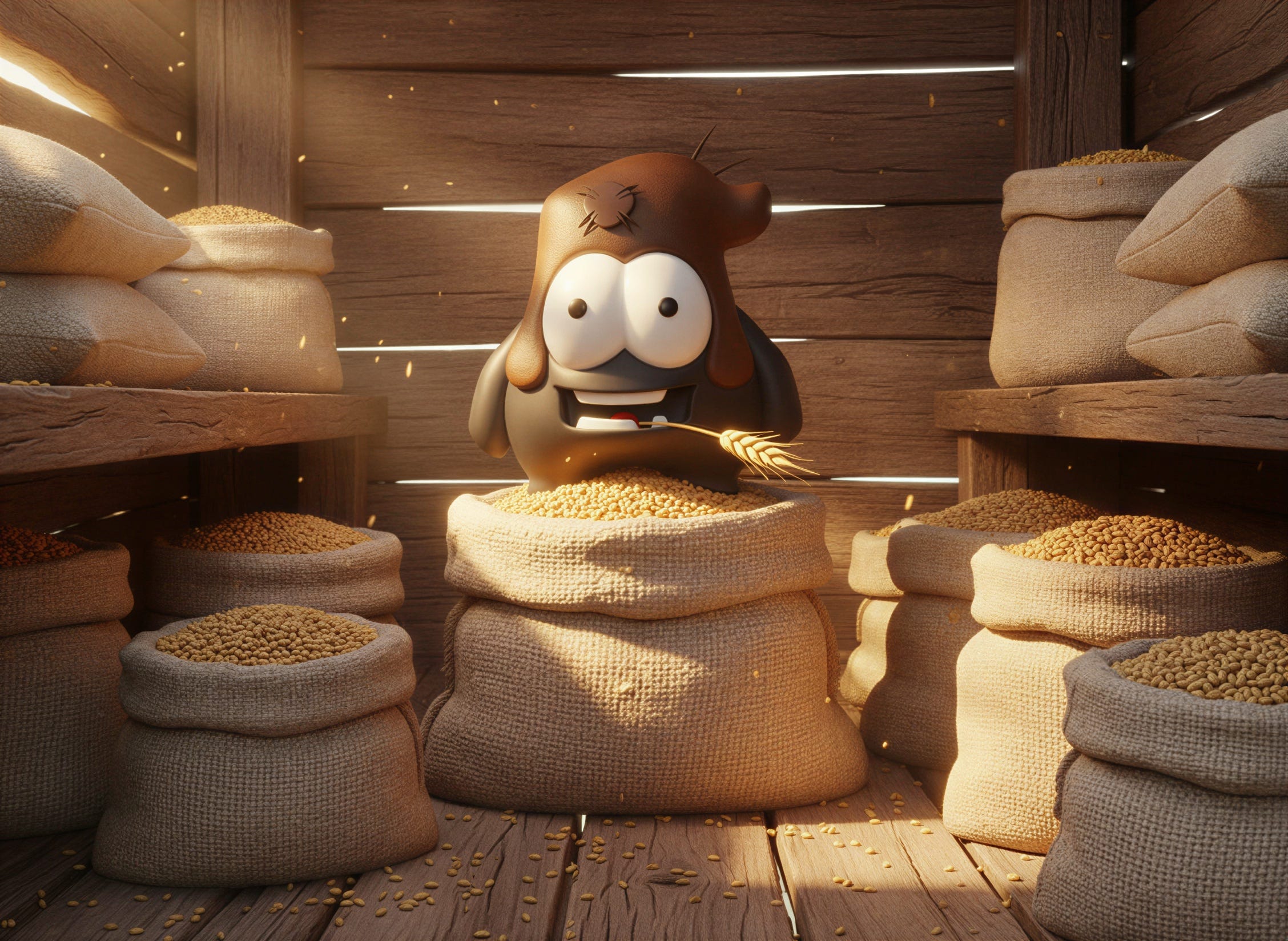
After Domovik and Bannik, I wanted to move further into the farm’s outer spaces and spend some time with another figure important to this world: Ovinnik, also approached here through the name Gumiennik ( sounds better to me, but i think it sounds better with the former one in global context- Ovinnik) or Jovnik.
Strictly speaking, older source traditions do not always treat these as perfect one-to-one synonyms. In Britannica’s overview of Slavic religion, the ovinnik is tied to the drying-house, while the gumenik is linked to the storehouse. At the same time, both belong to the same broader logic: each important part of the household economy had its own spirit, attached not to abstraction, but to a very specific place. For the purposes of Uboże, that closeness is exactly why I am comfortable bringing them together around one grain-bound figure.
That distinction matters to me because Ovinnik does not belong to the center of the house in the same way Domovik does, and he does not belong to the intimate heat of the bathhouse in the way Bannik does. He belongs to the space of harvest, storage, drying, and waiting — to the place where grain becomes security, but also where one accident can turn a season’s work into loss. Older descriptions of Slavic place spirits repeatedly connect them to specific structures and even to the very timber from which those structures were built.
Even the word gumno helps set that tone. In Polish historical usage, it referred not only to a farmyard with buildings, but earlier to harvested grain laid up for threshing. That older meaning is especially useful to me here, because it keeps the figure close not just to architecture, but to the material reality of grain itself.
That is what drew me to this character.
Ovinnik/Gumiennik feels less like a domestic companion and more like a keeper of reserves — a figure tied to what has already been gathered, what must be protected, and what remains exposed to fire, weather, neglect, or simple human carelessness. Britannica even notes a nineteenth-century Russian sacrifice made to the ovinnik in the drying house, which says a lot on its own: this was not treated as a decorative superstition, but as a spirit whose place had to be acknowledged.
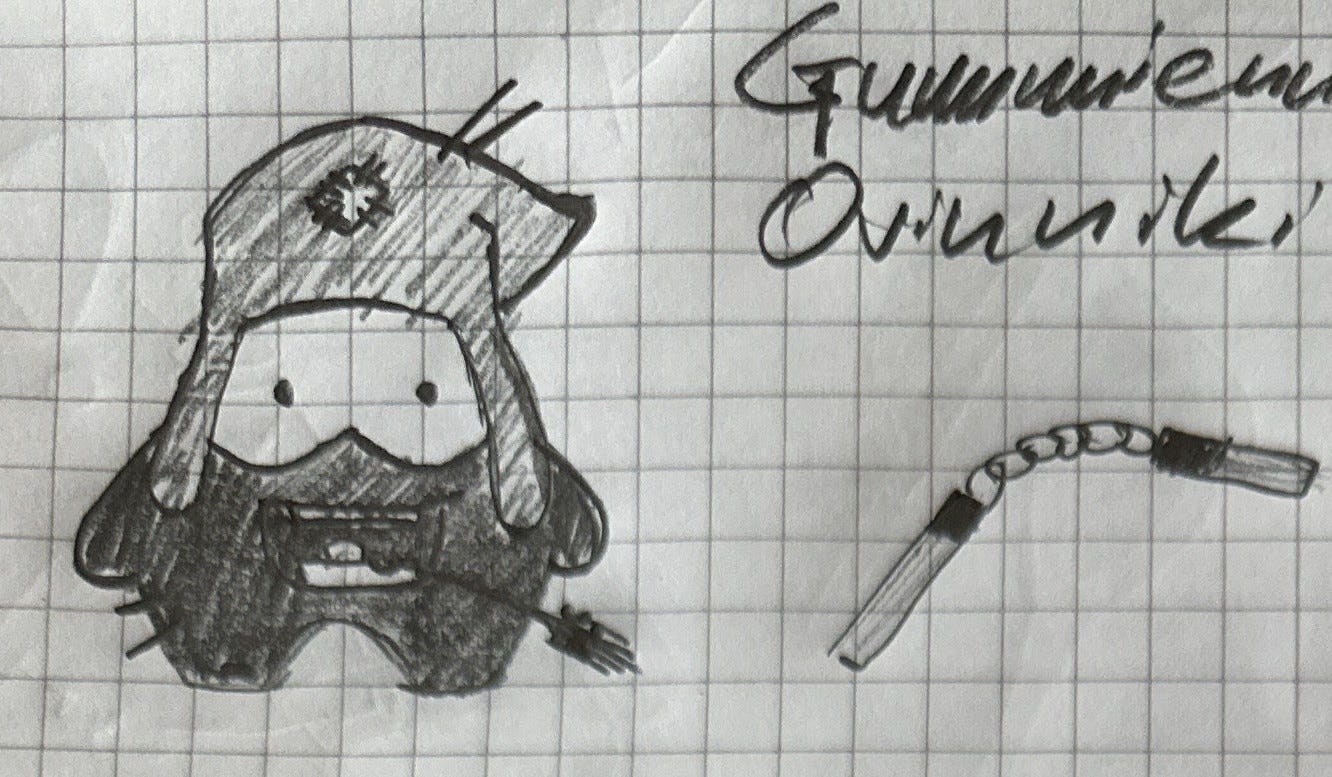
When I started drawing him, I wanted that to stay visible.

I did not want him to feel like just another small creature with a different hat. I wanted him to carry something of the barn, the threshing floor, the stored crop, and the rougher edge of farm life. That is why the design kept moving toward something simpler and sturdier: a compact silhouette, a worn cap, a piece of grain in the mouth, and a presence that feels a little more rural, a little more practical, and a little less “inside the home” than the other figures.
For me, that is where this character began to work.
Not as a perfect reconstruction, and not as an attempt to pin down one final folkloric image, but as a way of giving shape to a place and its mood. If Domovik is closer to the house itself, then Ovinnik belongs to the stored harvest just beyond it — to the part of the world where survival has already been gathered, but still has to be guarded.
And, as with the earlier figures, part of the work here was simply spending enough time with him for that logic to become visible. Sketching, simplifying, adjusting proportions, stripping things back, and trying to find the point where the character starts to feel less invented and more placed.
For now, this feels like the right direction.
Not final, not closed, but clear enough to move forward.